Saturday, April 20, 2013

March for José Antonio

     More than 200 people marched in Nogales on April 10 to commemorate the six month anniversary of the murder of 16-year-old José Antonio Elena Rodriguez by the Border Patrol.  José was walking along International Street when a Border Patrol agent fired into Nogales, Sonora on the night of October 10.  The autopsy report was released in February and shows that José was shot once in the head and seven times in the back.
     José’s family installed a cross on the sidewalk where he was killed.  Father Ricardo blessed the cross and people placed flowers and candles there in remembrance of José.  
     The Border Patrol claims the agent fired in self-defense after rocks were thrown at agents who were pursuing two drug smugglers.  Their brief statement noted that the agent “discharged his service weapon” and “one of the suspects appeared to have been hit.”
     Isidro Alvarez was an eyewitness to the killing and he spoke at the press conference prior to the march.  He was walking behind José and heard gunshots and saw him fall.  Isidro did not see or hear any rocks being thrown. 
     There is a surveillance tower about 100 yards from where José was killed and the cameras would have recorded the shooting.  The F.B.I. is still investigating the case six months later.  “I want to know who they are” said Aracely, José’s mother.  “I want them arrested and I want justice.”
     The bipartisan group of eight senators announced their immigration reform bill on April 16.  It includes $3 billion to increase border surveillance, $1.5 billion to build more walls and fences, and funding to hire another 3,500 border agents.  This support for increased militarization of the border will likely result in more marches and vigils here in Nogales in the future.       
     
"Peace and Justice on the Border"
Father Ricardo
Aracely


Thursday, March 28, 2013

Deporting José and Margarita to secure the border

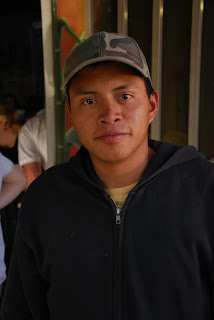
     “When we see people like you we don’t run and hide,” said José when I sat beside him at the Grupos Beta migrant center in Nogales on March 22.  “When we see them with their backpacks, and at the beaches, we treat them well.”
     José is 19 years old and from the southern state of Chiapas.  He and two companions had traveled the entire length of Mexico and then crossed into Arizona.  They hiked for five days in the desert and they ran out of water and food after the first three days.  In their desperation, they walked into the town of Tubac and found a store where they bought drinks and food.
     “People ran away and hid,” said José.  “They looked at us like we were from a UFO.  Someone called us ‘Mexican motherfuckers’ and they called the Border Patrol.”
     “The agent shoved me to the ground, put my hands behind my back, and then put his boot on my neck.”  José lifted his shirt and showed me the large scratch on his side.
     “When we were in the prison, they threw the food at us like we were animals.  They just gave us a small, cold hamburger and a carton of juice.  They turned on the air conditioning (to make it cold) and we could only wear t-shirts.”
     José had been deported to Nogales at 11 P.M. the previous night.  There are people who prey on migrants here and dropping them at the border late at night puts them at risk of being assaulted, robbed and extorted.
     “I don’t like America and I’m never going back,” concluded José.
     Margarita told me she was 22 years old and from the state of Guerrero when I talked with her at the Migrant Resource Center in Agua Prieta on March 8.  She had traveled two days by bus to get to the border.  She and a cousin then hiked for a day in the Arizona desert and were arrested by the Border Patrol.  Margarita was separated from her cousin in the detention center and she had just been deported to Agua Prieta that morning.  Her cousin had been carrying her cell phone with all the numbers and she had no idea how to communicate with her family.
     Margarita had hoped to travel to Oxnard, California to work with her cousins in the strawberry fields.  I seem to be lacking the insight used by the government because I don’t see how a young woman who wants to spend her days stooped over picking strawberries poses a grave risk to national security.
     “Because we live in an age where terrorists are challenging our borders, we can not allow people to pour into the U.S. undetected, undocumented, and unchecked,” said Barack Obama during the 2008 presidential campaign.  He failed to mention that not a single terrorist has been caught crossing the border from Mexico into the U.S. 
     After being re-elected with the support of the Latino vote, Obama announced his plan for immigration reform.  “I believe it should include a continuation of the strong border security measures that we’ve taken because we have to secure our borders,” he said.  The Obama administration deported more than 1.5 million people during his first term.  Making increased border security a top priority of reform will likely result in even more racism and brutality being used to protect freedom and democracy.
     Robin Williams, in his starting role as the space alien Mork in the “Mork and Mindy” show, gave a more accurate description of immigration enforcement more than 30 years ago.  He was almost deported from the U.S. for being an “illegal alien.”  Mork always communicated with his boss at the end of the program to inform him about activities on earth.  That week, he said “There’s this lady who is carrying a torch and she keeps saying ‘Send me your tired, your poor, and your huddled masses.’  Except there’s also a man down at the immigration office who says ‘Not too tired, not too poor, and not too many.’”
José

Margarita


Monday, February 18, 2013

In memory of Helen Nicholson

     My mother, Helen Nicholson, died yesterday afternoon.  She welcomed me into this world in her loving embrace and I told her how much I loved her as she was leaving here.  Her body will soon be reduced to ashes but I continue to feel the presence of her loving spirit.
     I was very blessed to grow up surrounded by her warmth and love.  She taught me about love through her example and that continues to inspire me.  I remember sitting on the porch with my sister while Mom read to us from our favorite books.  When we were able to read for ourselves she always made sure there were books in the house.  She would take us to the library and knew all our favorite authors.  She also volunteered at the school library and encouraged my friends to read by finding books that would interest them.
     When I grew up and moved away from Los Angeles, she visited me in various places where I lived – Arcata, Boise, Spokane, Helena, Missoula and Madison.  We also traveled together to my favorite place in the universe – the Canadian Rockies.  At age 76, she flew from Los Angeles to Indianapolis to meet me there at a Global Ministries conference when I was living in Colombia.  Throughout all those years, her home was always a refuge for me – stocked with my favorite foods and filled with her love.  It feels very strange to be here this morning without her.
     We shared a deep love for nature and a few years ago I found some prose she had written for a high school English class.  “Looking into the sky on a calm, cloudless night, can give me an achingly sweet sensation.  I realize that nature and the universe are so big and overpowering that they have the ability to calm my ruffled thoughts and leave me at peace with myself.  It always helps me to turn to nature, because that way I feel closer to God and to complete happiness.”
     I called Mom on February 11 to tell her about the snow that was falling in Nogales that evening.  It brought back memories of her childhood in Lake Bluff, Illinois and she talked about catching snowflakes on her tongue.  I called her the following evening and she chided me for not having tried that myself.  As we hung up, she told me “I love you Scott Douglas” – just like she did when I was a kid.  It seemed like she knew, in some way, that her life was coming to the end.
     As I told her yesterday, “I love you very much, I’m very grateful, and you can just let go.”
     In loving memory of Helen Nicholson,
     From her son, Scott
Mom, at age 14, at her favorite spot overlooking Lake Michigan

Mom, at age 81, watching the waves crash on the rocks at Cambria, California

Thursday, January 24, 2013

The people of Tirabichi

     Maria and Jesus showed me where they want to build their house in the Tirabichi dump of Nogales when I visited there on January 17.  They used to work sweeping the streets but that job ended and they’ve been working in the dump for two years.  Maria told me they sort through the refuse for plastic, glass, tin, aluminum and other recyclable materials.  They store what they’ve found and sell it once a week to the buyers that drive up to the dump.  They earn four to five dollars a day.  Jesus’ parents built a house in the dump a year ago and his father has worked there for ten years.
     The Diario de Sonora newspaper featured a front-page article on January 12 about the families that live at the dump.  The headline read “We feel more forgotten than cold.”  Tirabichi is less than a mile from the Hogar de Esperanza y Paz (HEPAC) community center and I walked up there the next day.  The high temperature that afternoon was 45 degrees and it dropped to 14 the following morning.
     Arturo and the Molina brothers showed me the shelters they had built and I can’t imagine what it would have been like there that night.  Arturo lived in Des Moines, Iowa and his children are still in the U.S. 
     Manuel is 40 years old and he grew up in the dump.  He lived in Tucson for six years, but the rest of his life has been there at Tirabichi.
     The conversations and images from that day stayed with me.  I talked with Sandra and Larry of the Tucson Samaritans, and Liz and Tricia who were visiting from Montana, and I returned to Tirabichi with them on January 17.  The intense cold had ended the day before and the odor was more evident as we walked up the hill.
     “We’re content because we’re able to work here,” Teresa told me.  “I only finished elementary school and that’s why I’m here.”  She has four children between six and seventeen years old, and she’s been working at the dump for six months. 
     The Clinton administration built a border wall to separate Nogales, Sonora from Nogales, Arizona in 1994 (the same year that the North America Free Trade Agreement was implemented).  The Obama administration replaced it with a larger wall in 2011 at a cost of four million dollars per mile.  The people at Tirabichi live less than four miles from where all that money was spent to keep them in poverty. 
     The HEPAC community center represents a grassroots alternative to the policies of inequality and exclusion.  A team from HEPAC was at Tirabichi when we arrived there.  They were inviting people to send their children to the lunch program and to participate in the adult education classes.  Teresa had the flyer and we talked about the opportunity to get her high school education at HEPAC.

Jesus and Maria on the site of their future home
   

Monday, December 10, 2012

The killing of Jose Antonio

     Two months ago today, 16-year-old Jose Antonio Elena Rodriguez was killed by the Border Patrol here in Nogales, Sonora.  Today is also International Human Rights Day commemorating the adoption of the Universal Declaration of Human Rights by the United Nations on December 10, 1948.  It seems like an appropriate moment to consider the impact of the United States’ militarization of the border.
     A Border Patrol agent in Nogales, Arizona fired at least 14 shots from his assault rifle into Nogales, Sonora on the night of October 10.  Jose Antonio was hit twice in the head and four times in the chest.
     The Border Patrol claims the agent fired in self-defense after rocks were thrown at agents who were pursuing two drug smugglers.  Their brief statement issued the following day notes that the agent “discharged his service weapon” and “one of the suspects appeared to have been hit.”
     “They ripped out a part of my soul” said Araceli, Jose Antonio’s mother, during a gathering of border organizations in Ciudad Juarez.  “He was and is part of my life.  I still hear his voice.  My son had a lot of dreams.  Why do they have to kill innocent people?”   
     I moved back to Nogales ten days after Jose Antonio was killed and I’ve been drawn to that site several times.  I went there the day after I returned here and my last visit was two days ago.  I’ve also walked along the U.S. side of the border wall near where the shots were fired.
     Jose Antonio was killed on the sidewalk in front of Dr. Luis Contreras’ home and clinic on International Street.  The agent placed the barrel of his rifle between the steel beams of the border wall and shot down into Nogales, Sonora.  That section of the wall is about 20 feet high and set on a hill that is 25 feet above the street.
     The initial shots were fired from at least 100 feet away and eight bullets hit the corner of the building.  The final shots were fired from about 50 feet away and three bullets hit that side of the building where Jose Antonio died.  It would have been extremely difficult to throw a rock from there and hit the agent who fired all those shots.
     The killing took place approximately 100 yards from a Border Patrol surveillance tower.  The video that was recorded by the cameras that night has not been released to the public or to Jose Antonio’s family.
     It would appear that the Border Patrol is able to get away with murder because the victim was Mexican.  Would the U.S. government show more concern if an agent on the northern border had killed a 16-year-old Canadian, or if the roles were reversed and Jose Antonio had shot into the United States and killed someone there?    
     “Why are they able to go out and kill here?” asked Araceli.  “Why are they covering them up?  I want to know who they are.  I want them arrested and I want justice.” 
     “There have been very many young people, teenagers, who have been killed at the border” said Navi Pillay, the United Nations High Commissioner for Human Rights.  “The reports reaching me are that there has been excessive force by the U.S. border patrols.”

Araceli with a photo of her son
Tito and Jeannette standing where Jose Antonio died (circles were drawn around the bullet holes)
The first shots were fired from the border wall above the car parked in the middle and the surveillance tower is on the left
The final shots were fired from that part of the wall


Thursday, July 19, 2012

Sentenced to death in the desert

     The president and members of congress sentenced a woman from Guatemala to capital punishment for crossing an imaginary line in search of work.  The sentence was carried out on June 30 in a remote section of desert 50 miles southwest of Tucson.  The woman was struggling to hike up a hill, collapsed face down on the ground, and died.  Her body was found two days later by a University of Michigan archaeology team that returned on July 15 to create a memorial.  It appears she was in her early 30s and her name is unknown.      
     Professor Jason DeLeon showed us the place where she died - a dark stain marked the ground.  He has hiked that trail many times in his work to preserve migrant artifacts (items left behind on the journey) and he often rested in the shade of the mesquite tree where they were building the shrine.  The view looking down the hill from there is starkly beautiful, but she was heading uphill and not able to focus on the scenery.
     Her sentence was imposed by the individuals responsible for policies and laws that enable U.S. corporations to freely move their products around the world while placing severe restrictions on the movement of workers.  The border city of Nogales, Sonora has nearly 100 assembly plants that manufacture goods for export to the U.S.  More than 3,000 people work in the Chamberlin factory producing garage door openers.  Those openers cross easily into Nogales, Arizona but the people that make them would have to hike for days in the southern Arizona desert if they dared to seek better-paying work in the U.S.
     Since the North America Free Trade Agreement was implemented in 1994, the border with Mexico has been enforced through a policy of “deterrence.”  Unauthorized immigrants are forced to cross through the most isolated and dangerous areas along the border.        
     The Border Patrol station in Nogales is the largest in the U.S. and a 20-foot-high border wall separates Nogales, Sonora from Nogales, Arizona.  The woman was prevented from safely crossing between the two sides of the city and, instead, had to cross through the remote desert about 30 miles to the west.
     A patrol from the Samaritans organization was driving along Batamote Road on June 30 when they encountered a young man from El Salvador who was in very bad condition.  He said he walked an hour to reach the road and he was seeking help for a woman from Guatemala who was dying.  He asked that the Border Patrol be called to rescue the woman.  The Border Patrol didn’t find her, but they did apprehend the young man and he was then taken to the hospital.
     The mission of Samaritans is to save lives in the Southern Arizona desert by providing humanitarian aid to migrants in distress.  It is an expression of compassionate resistance to policies and laws that enable garage door openers to cross the border while punishing people that are crossing in search of a better life.


Friday, June 29, 2012

Vigil at the Tent City jail

     Three men dressed in camouflage and armed with assault rifles were watching us as we stepped off the bus to protest sheriff Joe Arpaio’s tent city jail in Phoenix on June 23.  Sheriff agents on horseback and with an ATV, patrol car, and SUV were posted just down the street.  They weren’t concerned about the armed civilians but they did video people who walked by porting “Standing on the Side of Love” placards.
     The Unitarian Universalist Association (UUA) was holding its general assembly in Phoenix and more than 3,000 people participated in the candlelight vigil outside the jail.  Peter Morales, UUA president, was given a tour of the jail by Arpaio and he said it seemed like “what you’d see in a fascist country.”  Geoffrey Black, president of the United Church of Christ, called it “a national disgrace.”
     We all chanted “Close it down!” with enough force to be heard inside the jail.  The inmates are kept in tents where they have to endure the heat of summer and the cold of winter.  The temperature reached 106 degrees that day and was still over 100 at 9 P.M.  Arpaio calls himself the “toughest sheriff in America.”
     The sheriff has ordered sweeps of Latino neighborhoods to round up people suspected of being unauthorized immigrants.  A Department of Justice (DOJ) investigation concluded that Arpaio oversaw the worst pattern of racial profiling by a law enforcement agency in U.S. history.  The sheriff and his commanders created a culture of abusing the rights of Latinos.  The DOJ filed a lawsuit against Arpaio last month because of “unlawful discriminatory police conduct directed at Latinos.”
     Standing on the Side of Love is a campaign sponsored by the UUA to “harness love’s power to stop oppression.”  The day after the UUA assembly ended, the Supreme Court upheld the clause of Arizona’s law SB1070 that requires police to check the immigration status of people they stop and suspect are unauthorized immigrants.   UUA moderator Gini Courter said, “It violates our faith to comply with SB1070 and we are called to resist the mass detention and deportation of immigrants.”